
For most students the honest answer is robotics first and IoT second: robotics from roughly age 8 to 11, then IoT from about age 12, once a child is comfortable with a circuit and a loop of code. The two are not rival subjects. Robotics teaches a machine to move, IoT teaches a machine to report, and both sit on the same foundation of electronics, sensors and programming.
Parents often use "robotics" and "IoT" interchangeably, but they are different paths that build different skills. Knowing the difference helps you choose the right first step. The good news is that they overlap a great deal, and starting either one sets a child up for the other.
What follows is how we explain the choice to parents and school heads who ask us this most weeks: what each subject really is, where the syllabus is shared, where the two part ways, what each costs to begin, and the sequence that works for the majority of children.
What each one actually is
Robotics: machines that move
Robotics is about building machines that move and act in the physical world. Motors, wheels, arms, sensors and the code that makes them respond. A line-following car or a robotic arm that sorts objects is classic robotics. It is visual, kinetic and instantly rewarding for younger children, because the feedback loop is short. Change one number in the code, upload it, and the robot turns differently within seconds.
The hard part of robotics is rarely the code by itself. It is the meeting point of code and physics. A wheel slips on a polished floor, a battery sags under load and resets the board, a servo overshoots, the chassis is heavier on one side than the other. Children learn to debug a system where software is only half the problem, which is a habit that transfers to almost every engineering subject afterwards.
IoT: devices that sense and report
IoT, the Internet of Things, is about devices that sense and communicate. A sensor reads data, sends it over Wi-Fi, and you see it on a phone or dashboard anywhere in the world. A weather station that messages you when it rains is IoT. It leans more towards data, networks and the cloud than towards mechanics.
The hard part of IoT is invisibility. When a robot fails, you watch it fail. When an IoT node fails, the dashboard simply stops updating, and the student has to reason about where the break happened: the sensor, the wiring, the board, the Wi-Fi credentials, the broker, or the dashboard itself. That is a genuinely different thinking skill, and it is the main reason we rarely start eight year olds there.
The foundation both subjects share
Before separating them, it is worth being precise about how much of the material is identical. In our own classes, the first six to eight weeks of a robotics course and an IoT course are close to the same syllabus, taught with different examples.
- Basic electronics. Voltage, current and resistance; why a resistor sits in front of an LED; what ground actually means; how the rows and rails of a breadboard are wired internally.
- Reading a sensor. Digital versus analogue signals, thresholds, noise, and why a raw reading of 512 is not a temperature until you convert it into one.
- The microcontroller loop. In an Arduino sketch that is setup() and loop(). The idea that the board repeats the same instructions hundreds of times a second is the single most important concept in both subjects, and it is the one most beginners take longest to internalise.
- Programming logic. Variables, conditionals, loops and functions. Whether the child writes it in block code, Arduino C++ or MicroPython, the logic underneath does not change.
- Debugging habits. Change one thing at a time, print values to the serial monitor, check power and wiring before blaming the program.
That shared base is why the decision is far less permanent than it feels when you are standing in front of two course brochures. A child who has spent a term on robotics already owns most of what an IoT course assumes on day one, and the reverse is equally true.
You do not have to pick forever. Both share the same foundations: circuits, sensors and programming. A child who starts with one can pivot to the other in weeks, not years, because only the top layer of the subject actually changes.
Where robotics and IoT genuinely diverge
Hardware
Robotics pulls a child towards actuators and mechanics: BO gear motors, hobby servos such as the SG90, stepper motors, motor drivers like the L298N or TB6612, wheels, chassis plates, castor wheels and eventually 3D printed brackets. Power supply becomes a real topic very quickly, because a motor that stalls will draw enough current to brown out the board and restart the program halfway through a task.
IoT pulls a child towards sensing and radio. The board of choice shifts from a plain Arduino Uno to an ESP32 or an ESP8266 NodeMCU, because Wi-Fi is built in and no shield is needed. The sensors get more specialised: DHT11 or DHT22 for temperature and humidity, the MQ series for gas and smoke, HC-SR04 for distance, BMP280 for pressure, a capacitive probe for soil moisture. Power still matters, but the question becomes battery life across weeks rather than current draw across seconds.
Software
Robotics code stays local and is timing sensitive. A student works with PWM to set motor speed, maps a sensor reading onto a motor response, writes small state machines (searching, following, turning, stopped), and by the later stages meets a PID controller so that a line follower stops wobbling down the track. Almost nothing leaves the board.
IoT code is mostly about moving structured data safely from one place to another. Connect to Wi-Fi, format a reading as JSON, publish it over MQTT to a broker or POST it to an API endpoint, handle a dropped connection without crashing, choose a sensible sampling interval, then read the values back on a dashboard such as ThingSpeak, Blynk or Node-RED. Older students meet timestamps, retries and the first real security lessons of their lives, including why a Wi-Fi password should not be hard coded into a sketch that later gets pushed to GitHub. Our explainer on how IoT works, explained for students walks through that chain end to end.
The question each subject is trying to answer
Robotics asks: how do I make this thing perform the right physical action. IoT asks: how do I know what is happening somewhere I am not. Put to a child in those words, most of them will tell you within a minute which question they find more interesting, and that instinct is usually worth trusting more than a syllabus comparison.
What a child actually learns, term by term
In a robotics course
- Assemble a chassis, wire two motors through a driver, and make the robot drive forward and stop on command.
- Add an IR sensor pair and write the conditional logic that turns it into a line follower.
- Add an ultrasonic sensor for obstacle avoidance, then combine two behaviours in a single program without them fighting each other.
- Introduce a servo and build something that grips, sorts or lifts.
- Tune it: gear ratios, speed against accuracy, and the discovery that the same robot behaves differently on tile, carpet and chart paper.
By the end of a term the child owns a working machine they can demonstrate to a room. The technical output matters, but the confidence is the real result, and it is why we still recommend robotics as the entry point for younger students.
In an IoT course
- Get an ESP32 onto the home Wi-Fi and print its IP address to the serial monitor.
- Read one sensor and push the value to a dashboard every ten seconds.
- Add a second sensor and a threshold alert, for example a message when soil moisture drops below a set value.
- Add control in the other direction: a button on a phone that switches a relay at home.
- Log a week of readings and work out what the graph is actually saying.
That last step is the one parents underrate. Looking at a week of your own data and realising the humidity spike happens every evening at the same time is where data literacy starts, and it is a skill no robotics kit teaches on its own.
Which subject suits which child
Temperament is a better guide than marks in science. After a few hundred students you start to see two rough profiles.
- Robotics suits the child who takes appliances apart, builds elaborate things out of LEGO, wants an immediate physical result, and gets restless when a lesson stays abstract for too long.
- IoT suits the child who likes patterns, screens and dashboards, asks how an app knows something, is patient with problems that cannot be seen, and enjoys the idea that something they built keeps running while they sleep.
Two cautions. First, temperament at nine is not destiny at fifteen; plenty of children who arrive obsessed with motors end up writing the cloud side of the project three years later. Second, the loudest signal is often the friend group rather than the subject, and a child who joins a robotics batch because two friends are in it will still learn the same electronics. That is a perfectly good reason to start.
What each costs to start
Component prices below are typical Indian retail at the time of writing, with rough Dubai equivalents. Both routes are cheaper than most parents expect, and neither needs a laptop better than the one already at home.
A robotics starter setup
- Arduino Uno compatible board: roughly INR 500 to INR 900, about AED 25 to 45
- Two BO gear motors with wheels, a chassis plate and a castor: roughly INR 700 to INR 1,200, about AED 35 to 60
- L298N motor driver module: roughly INR 150 to INR 250
- An IR sensor pair and one HC-SR04 ultrasonic sensor: roughly INR 250 to INR 400
- Battery holder, cells, jumper wires and a breadboard: roughly INR 400 to INR 700
Call it INR 2,000 to INR 3,500, or roughly AED 100 to 175, for a set of parts a child can rebuild into several different robots. Branded classroom kits cost several times that, and it is worth being clear about what the premium buys: packaging, moulded parts and lesson plans, not better electronics.
An IoT starter setup
- ESP32 development board with built in Wi-Fi: roughly INR 400 to INR 700, about AED 20 to 35
- DHT11 temperature and humidity sensor: roughly INR 100 to INR 200
- A soil moisture probe or an LDR light sensor: roughly INR 80 to INR 200
- Single channel relay module for switching a lamp or a pump: roughly INR 120 to INR 250
- Breadboard, jumper wires and a USB data cable: roughly INR 300 to INR 500
That lands around INR 1,200 to INR 2,000, or roughly AED 60 to 100. The dashboards a beginner needs are free at student volumes, whether that is ThingSpeak, the Blynk free tier or a self hosted Node-RED, so there is no cloud bill attached to a school project. A Raspberry Pi is optional and can wait until the child needs a camera, a database or a local server; our notes on Raspberry Pi projects for teenagers cover when that step is worth taking.
Why the honest answer is a sequence, not a choice
For most children, here is our rule of thumb.
Ages 8 to 11: start with robotics
Movement is exciting and concrete, and it builds confidence fast. Block based tools such as Scratch or mBlock are fine at this stage, and there is no rush towards typed syntax. The goal for these years is not a language, it is the settled belief that a machine will do exactly what you tell it, including the wrong thing when you tell it wrongly.
Ages 12 to 15: add IoT
IoT becomes a natural next step, adding sensors, Wi-Fi and data to what the child already knows. This is also the right window to move from blocks to text, usually Arduino C++ first and MicroPython soon after. Our piece on why Arduino works as a first board for students covers that transition, and the one on the best age to start IoT and coding goes deeper into readiness signals.
Ages 16 to 22: stop separating them
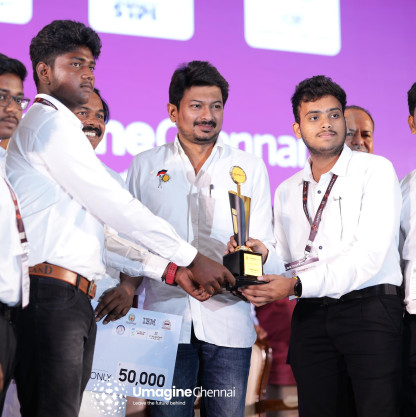
By this stage the distinction stops being useful. A greenhouse that measures soil moisture, decides on a threshold and drives a water pump is robotics and IoT in one board. This is the level at which school science fairs, hackathons and college mini projects start to reward students, and it is where our own team competes; Fizon Tech won the Smart India Hackathon 2022 Grand Finale in the hardware category with precisely this kind of combined build.
"Robotics gets them hooked. IoT teaches them to connect what they build to the wider world. The ideal journey uses both."
Where the two paths lead after school
Robotics tends to lead towards mechanical and mechatronics engineering, control systems, industrial automation and PLC work, drones, and manufacturing. IoT tends to lead towards embedded firmware, cloud and backend development, data engineering, networking and product engineering. Neither is a narrower door than the other, and both remain open through a standard engineering degree.
The more useful observation is that embedded firmware sits in the middle of the two, and that is where a great deal of the actual work is. Fizon Tech has been building hardware and software for clients in more than 12 countries from offices in Trichy and Dubai since 2022, and the engineers who are hardest to replace are consistently the ones who can read a datasheet in the morning and write the service that consumes the data in the afternoon. That combination begins in school, not in a first job. For a fuller picture, read our guide to IoT career paths for students.
What to do next
If you are deciding this week, keep it small and practical.
- Ask your child which question they find more interesting: making a machine move correctly, or knowing what is happening somewhere they are not. Take the answer seriously.
- Buy the smaller kit before the bigger course. One weekend and under INR 2,000 is enough to find out whether the interest is real; our list of beginner IoT projects kids can build at home is a reasonable starting point either way.
- Watch what happens at the first genuine frustration, when the robot will not turn or the dashboard will not update. Children who push through that point are ready for a structured programme.
- Then give it structure, because the second term is where progress actually compounds. Our IoT, robotics and STEM programme for students aged 8 to 22 sequences robotics into IoT rather than asking families to choose between them.
If you are still unsure after all of that, choose robotics and stop worrying. It is the easier subject to fall in love with, and every hour spent on it counts towards the IoT work that follows.
Written by Ramesh Kannan, CTO at Fizon Tech. He leads the hardware and firmware side of Fizon Tech's client work and designs the robotics and IoT curriculum taught to students aged 8 to 22 across Tamil Nadu and the UAE. Explore our IoT programme or get in touch.