
We believe every student deserves the skills to build the connected world of tomorrow. Our hands-on programme has already transformed how 500+ students think about technology, and this is the story of why we built it, what happens inside our workshops and what we have learned about teaching IoT to young minds.
The problem we saw in every classroom
Visit any school in Tamil Nadu and you will find students who use smartphones, tablets and apps every single day. They stream videos, play games and browse the internet effortlessly. But ask them how any of it works, and you will get a blank stare.
That gap, between using technology and understanding technology, is what our IoT education programme was built to close. The students who understand technology are the ones who will build the companies, the products and the systems that the rest of the world depends on. We wanted more of those students to come from India.
"The future belongs not to those who consume technology, but to those who create it. Our job is to make creators out of curious students."
What IoT education actually looks like in practice
When most people hear "IoT for kids," they imagine children passively watching a screen or following a step-by-step worksheet. Our programme is the opposite. From the very first session, students are touching components, asking questions and making things work with their own hands.
A typical Level 1 session for our youngest students, aged 8 to 12, goes something like this:
- Students receive a breadboard, LEDs, resistors and a 9V battery. No instructions yet, just the components.
- They try to figure out what everything does through exploration and experimentation.
- When something works, they share it with the group. When it fails, we talk about why together.
- By the end of the two-hour session, every student has built at least one circuit that does something they designed.
The moment a student realises that they made something light up or move or buzz by their own doing is the moment everything changes. That instant of ownership is more powerful than any textbook.
The three-level curriculum we designed from scratch
We did not find an existing curriculum that matched what we wanted to achieve, so we built our own. It is structured around three levels that mirror how a professional engineer actually develops skills, not how textbooks are traditionally arranged.
Level 1: Explorer (Ages 8 to 12)
This is where curiosity comes first. Students learn the basics of electricity, components and circuits through purely hands-on experiments. No coding yet. We want them to build a physical intuition for how things connect before adding the abstraction of code. Every student leaves with a simple circuit they built and a genuine sense of accomplishment.
Level 2: Builder (Ages 12 to 17)
This is the breakthrough level. Students are introduced to Arduino, and for the first time, they can write a few lines of code and watch something in the physical world respond. Sensors read temperature. LEDs blink in patterns they programmed. Motors spin at speeds they control. The eight-week structured course ends with each student presenting their own IoT project that solves a real problem they chose themselves.
Level 3: Innovator (Ages 17 to 22)
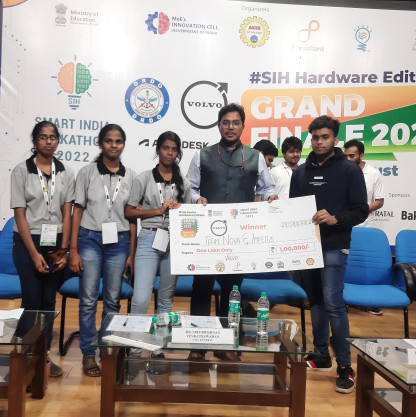
At this level, students are working with Raspberry Pi, Python, wireless communication and cloud dashboards. They build full IoT systems where sensor data flows to a server and can be visualised in real time on a screen they built. Several Level 3 graduates have gone on to compete in SIH and other national STEM competitions, with two teams reaching finals in the past two years.
What students actually learn beyond the technology
The skills visible on the surface, electronics, coding, IoT protocols, are only part of what we teach. Our instructors consistently observe that the deeper impact is on how students approach problems in general.
- Systematic debugging: when a circuit does not work, students learn to isolate variables, test assumptions and think logically rather than randomly changing things and hoping for the best.
- Resilience: most IoT projects fail many times before they succeed. Working through failure repeatedly teaches persistence in a way no lecture can.
- Presentation confidence: every student presents their project at the end. Explaining what you built and why to a room of peers builds communication skills that last a lifetime.
- Collaborative design: many projects are team efforts, and students learn to divide work, integrate components built separately and support each other when stuck.
"I never thought I could build a real device. Now I want to study embedded systems engineering." A Level 2 student, aged 15, Trichy
The challenge of making it affordable and accessible
One of our core values at Fizon Tech is that excellence should not be a luxury. We apply that principle to our IoT education programme as aggressively as we apply it to our software services.
We subsidise hardware kits so that cost is never a barrier to entry. We run workshops in government schools, not just private institutions. We travel to colleges in smaller towns rather than only serving the major cities. Our instructor team is multilingual and comfortable teaching in Tamil, which immediately removes the intimidation barrier that English-only instruction creates for many students.
We have also built a donate-a-kit programme that allows businesses and individuals to sponsor an IoT kit for a student who cannot afford the materials. Several companies in the UAE, where we also operate, have contributed through this programme.
What we have learned after 500 students
Running this programme across schools, colleges and community centres has taught us as much as it has taught the students. A few lessons that every educator running similar programmes should know:
- Curiosity, not age, is the real predictor of success. Some of our most impressive project outcomes came from students in the youngest age group.
- Failure events are the best teaching moments. The session where a student accidentally short-circuits a component and learns exactly why teaches more about circuit safety than any diagram.
- Parental involvement accelerates learning. When parents attend the final project showcase, students prepare more carefully and speak about their work with significantly more confidence.
- The first project should be completed in a single session. If a beginner cannot make something work on day one, they lose motivation before the real learning begins.
Two of our Level 3 graduates are now pursuing degrees in embedded systems and electrical engineering. Watching that happen, knowing our programme was part of that journey, is why we keep building it.
How to get your school or child involved
If you are a parent curious about enrolling your child, a school principal interested in running a programme for your students, or a college coordinator looking for a technical workshop partner, we would love to talk with you.
We offer several formats to fit different needs: single-day introductory workshops, weekend two-day intensives, eight-week structured courses and full semester partnerships with colleges. All formats include instructor-led sessions, take-home materials and a certificate of completion.
Reach out through our contact page or call us directly at +91 6369803770. We respond within 24 hours and are happy to run a free demonstration session so you can see the programme in action before committing.
Written by Senthil, Co-Founder at Fizon Tech. Fizon Tech is a digital agency offering software development, hardware sourcing, AI services and IoT education across UAE and India.